Bible Journaling Ideas
Most bible journaling ideas start with supplies. This one starts with 3 lines: the reference, what you noticed, and what you'll do about it. That's the whole entry, it takes about 40 seconds, it works in a cheap notebook with a biro, and the measure is whether you're noticing more than you were a month ago.
What should I put in my Bible journal?
3 things: the passage reference, one line on what you noticed, and one line on what you'll do. Everything else is optional, including every art supply you have seen recommended. Keep the daily entry short enough to finish in under a minute, or you'll stop by the third week.
If you can't draw, you can still do this
The reason bible journaling looks like an art project is that artists got there first and photographed it well. Their pages are lovely and they are also a hobby, sitting on top of a practice that works without them.
You can tell the two apart by asking what happens if you remove it. Take away the watercolour and the practice is intact. Take away the writing and there's nothing left.
So none of what follows needs a brush pen, a journaling bible, tip-ins, or a steady hand. If you enjoy that side of it, enjoy it. If you've been put off for years because your handwriting is bad and you can't draw a straight line, that was never the barrier you thought it was.
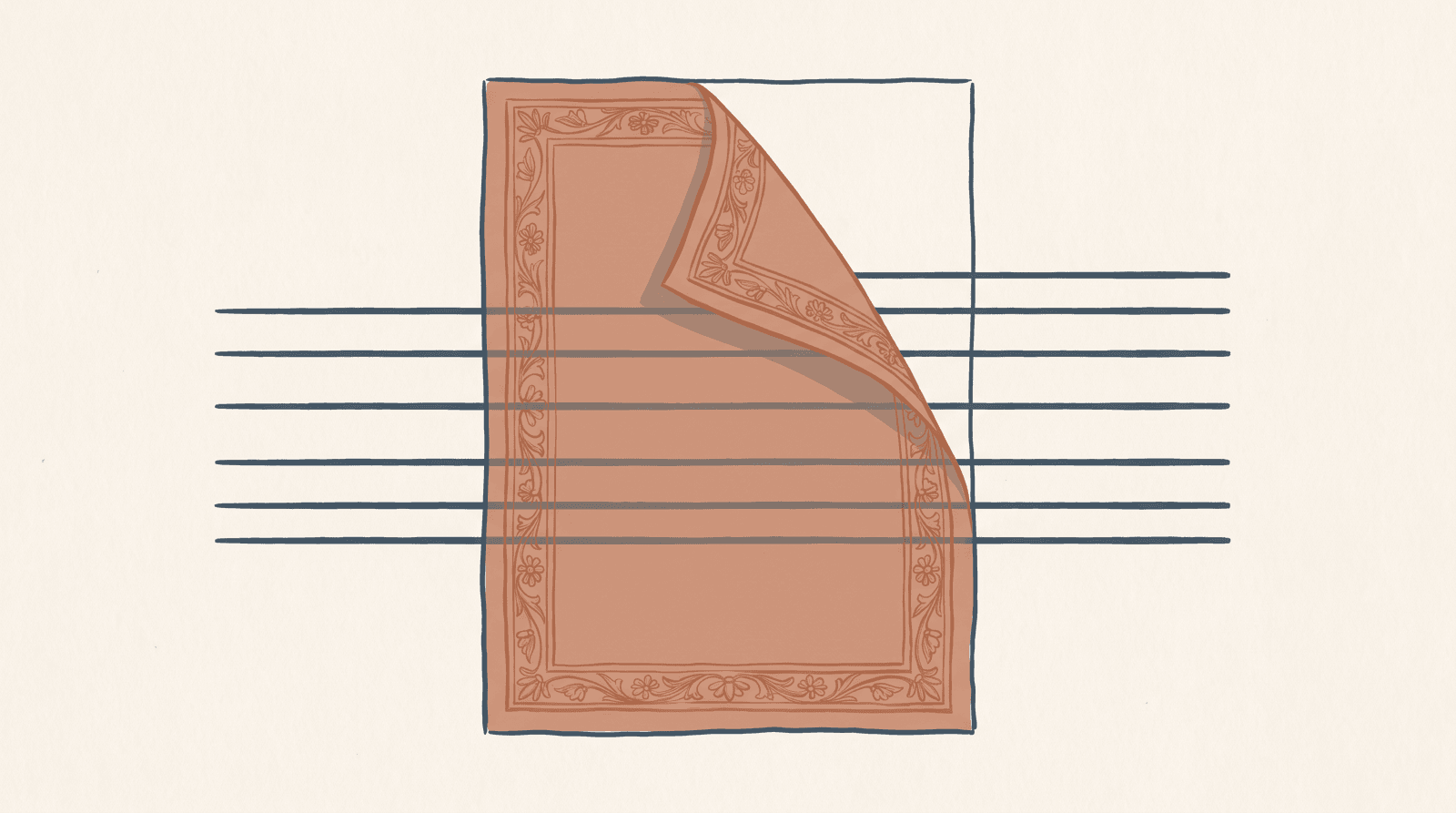
What goes in a Bible journal?
3 things. Everything past that is preference.
The reference. Book, chapter, verse. It takes 4 seconds and it's what lets you find your way back.
One line on what you noticed. The thing that caught you, or bothered you, or that you'd have read past a year ago, rather than a summary of what the passage said.
One line on what you'll do. Small enough to do today. If nothing comes, write that nothing came, which is an honest entry and a more useful one than a paragraph you invented to fill the space.
Worth saying what the middle line is for. You're writing down what God said and what you heard in it, rather than curating an interesting text, and those two habits look identical on paper for about a fortnight before they diverge completely.
Jesus put the failure mode bluntly to people who read more than most: "You study the Scriptures diligently because you think that in them you have eternal life. These are the very Scriptures that testify about me, yet you refuse to come to me to have life" (John 5:39-40, NIV). A full journal is not evidence against that happening.
A blank page is harder than a small box. Given a page, most people write nothing because they're waiting to have something worth the space. Given 3 short lines, they write, because 3 lines is clearly not asking for an essay.
What to leave out: a retelling of what you just read, anything written for an imagined reader, and any attempt to be profound on a Tuesday.
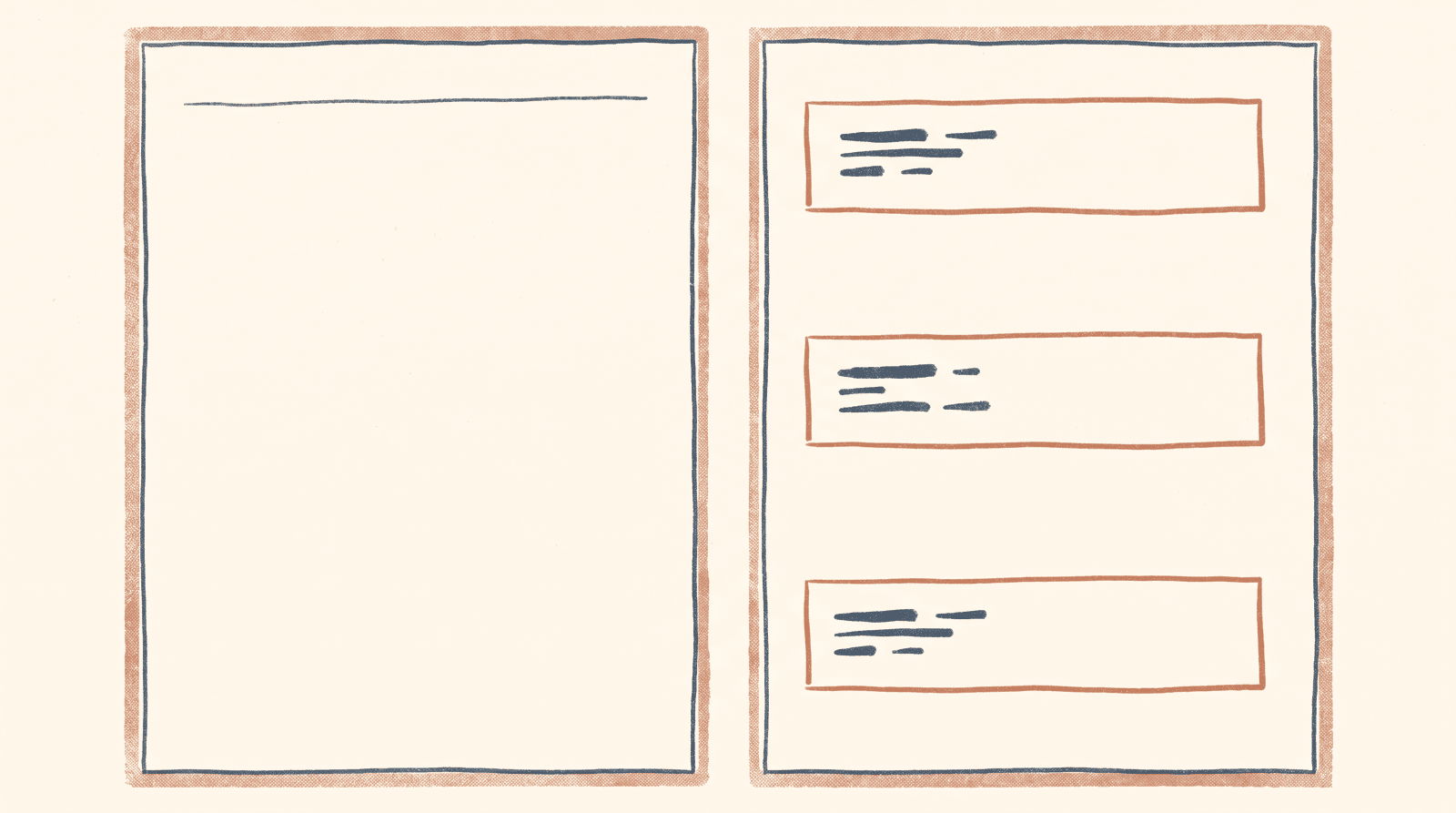
What about S.O.A.P., the 5 P's, and the 3-3-3 method?
S.O.A.P. is the one with a stable form and it's genuinely good: Scripture, Observation, Application, Prayer. If you want more structure than 3 lines, use it.
The other 2 are worth being straight about. The 5 P's of Bible study has no single agreed list. Search it and you'll find several versions, most of them alliterative rearrangements of the same advice, and none of them carries any particular authority.
The prayer side of this has the same problem, and these prayer journal ideas work through ACTS and the P's of prayer the same way.
The 3-3-3 method isn't a Bible study method at all. It comes from general journaling and anxiety practice, usually 3 things you're grateful for, 3 you're worried about, 3 you'll do. You can point it at scripture, but nobody should tell you it's a way of reading the Bible, because it isn't one.
Here's the distinction that matters. A method tells you what to write once you've opened the book, and has nothing to say about whether you open it.
Most people who quit didn't quit because their observation section was weak.
How to start, in the first 40 seconds
Read the passage you were going to read anyway. Then write the reference and one line.
That's day 1, with no new reading plan and no supplies order.
I time this at about 40 seconds, which is my own count rather than anything measured properly. What matters is that it's small enough to displace nothing. A practice that needs 20 minutes makes you choose between it and whatever those 20 minutes were already doing, and that's a fight you'll lose most weeks.
One line rather than a paragraph, for the same reason. The paragraph is where it starts feeling like homework, and homework is what you skip when the week gets bad.
Dallas Willard put the principle better than I can. A discipline, he wrote, is "something in my power that I do to enable me to do what I cannot do by direct effort".
Writing a line is in your power. Being changed by what you read isn't, at least not on demand. So you do the part you can do, and the other part is God's work rather than yours.
Where to keep the pen
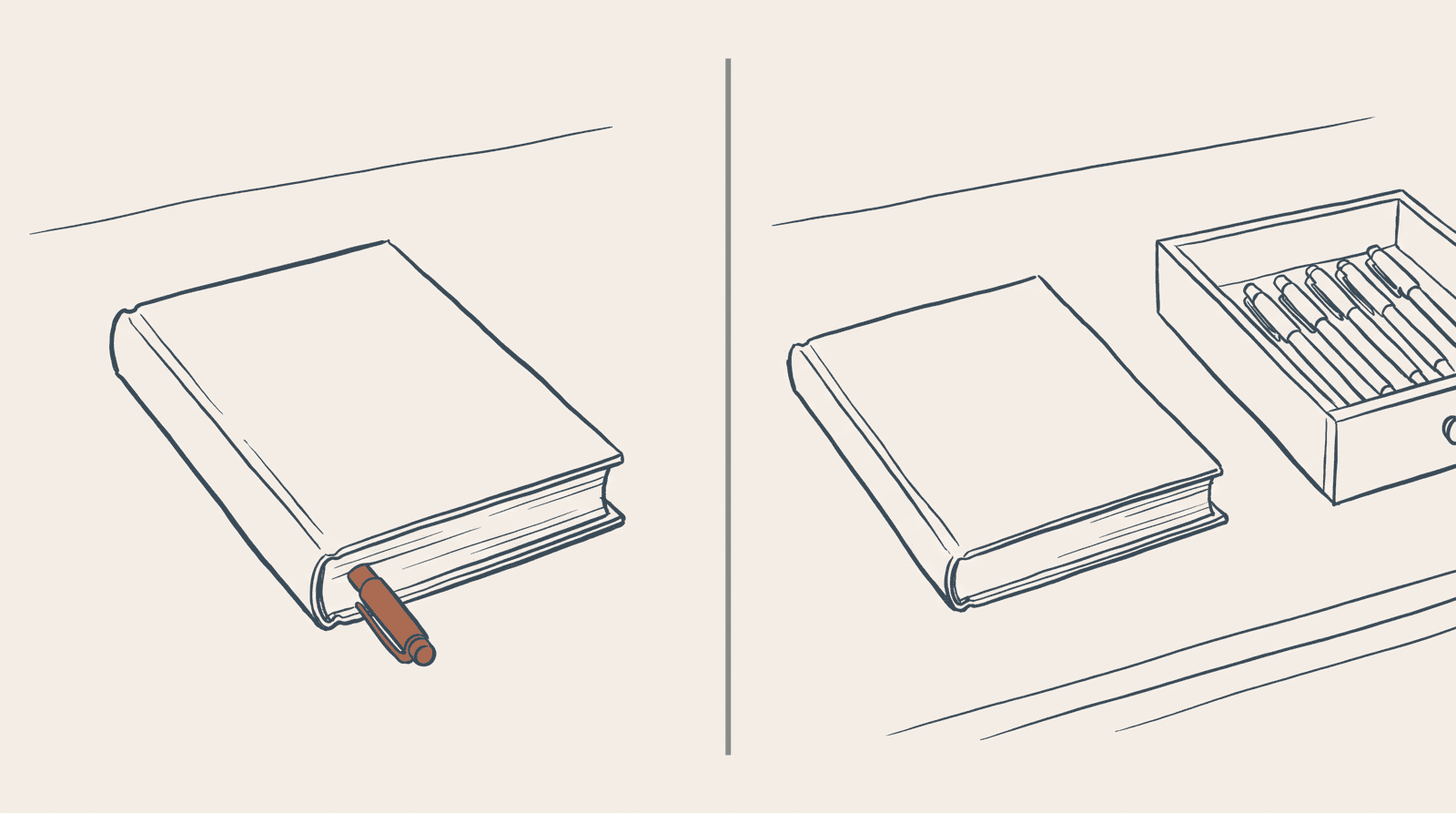
The pen lives inside the Bible. Opening the book puts it in your hand, so the trigger is the thing you were already doing.
A supplies drawer is a shopping list you have to remember to visit, and you won't.
The idea is older than any productivity book. Israel was told to put the words where they'd be walked past: "These commandments that I give you today are to be on your hearts... Write them on the doorframes of your houses and on your gates" (Deuteronomy 6:6-9, NIV). Doorframes and gates are the places you pass without deciding to.
If the pen goes missing and the practice stops, that's information about the cue rather than about you. Put another pen in the book.
Why "does it look good" is the wrong question
A beautiful page is an output, and outputs are the easiest thing in the world to mistake for progress.
You can produce a page that photographs well on a week when you read nothing carefully. You can also scrawl 6 words on a bus and have that be the week something moved.
So track the thing you can be honest about. At the end of the month, read your first week's lines and then this week's. Are you noticing more in the text than you were, or the same amount with better handwriting?
There's good evidence that writing it down does work. Harkin and colleagues reviewed 138 studies covering 19,951 people and found that monitoring progress toward a goal genuinely helps you reach it (d+ = 0.40), with a larger effect when the information is physically recorded rather than just noticed.
Their work covers goal progress in general, though. No study I've found tests progress monitoring on spiritual formation, so applying it here is a reasonable inference rather than a measured result, and 0.40 is a moderate effect rather than a dramatic one.
And the worry about the page is rarely about the page. It's usually a worry about whether you're any good at this, which is a question about you.
On that, scripture is blunter than most of the internet: "The LORD does not look at the things people look at. People look at the outward appearance, but the LORD looks at the heart" (1 Samuel 16:7, NIV). Samuel was sizing up a family of sons at the time, so the verse is about people rather than pages. It still settles the question underneath yours.
What if you've tried this and stopped?
You will miss days. Missing a day does not undo this.
That's what the research found. Lally and colleagues, tracking how habits actually form, put it plainly: missing one opportunity to perform the behaviour "did not materially affect the habit formation process".
This is why there's no streak on the template. Build a grid and the person who misses Thursday quits on Friday, because now there's a visible hole with their name on it.
A half-finished page is a half-finished page. Start again on the next line, whatever day it is.
The practice
The action. After you read, write the reference and one line: what you noticed. Nothing else.
What it costs. About 40 seconds, by my own count. It displaces nothing, which is the point of it being first.
Where to put it. The pen lives inside the Bible. Opening the book is the trigger, not a drawer and not a shelf.
How you'll know it's working. At the end of the month, read your first week's lines against this week's. The question is whether you're noticing more than you were.
And noticing is only the evidence. It means you're listening to someone, and he is the point.
The page can look terrible and the month can still have been a good one.
Common questions
Can you give me an example of a Bible journal?
Here is the shape of one: "Ps 73:26. Asaph says his flesh and heart fail and God is still his portion, which is a stranger thing to say than I had noticed. Today: message the friend whose year has been exactly that." 3 lines, under a minute, no decoration. That is a complete entry and there is nothing missing from it.
What are some good prompts for a daily Bible journal?
The best prompt is the one you don't have to choose, so use the same 2 questions daily: what did I notice, and what will I do. Rotating prompts give you a decision to make before you've written anything, and a decision at the start is where most days are lost. Save variety for the weekly review.
What is the 3-3-3 journaling method?
It's a general journaling technique, usually 3 things you're grateful for, 3 worries, and 3 things you'll do. It comes from anxiety and wellbeing practice rather than from Bible study, and it isn't a way of reading scripture. You can use it alongside your reading if it helps, as long as nobody sells it to you as a Bible method.
What not to do when journaling?
Don't retell the passage, don't write for an imagined reader, and don't leave the entry until the evening when you'll be tired. The most common failure isn't a bad entry, it's an unbounded one: a person who plans a full page writes nothing on the day they have 4 minutes. Keep the floor low enough that a bad day still clears it.
Get the template
The prayer journal template is 4 pages you can print: a baseline page, a daily line, 5 weekly questions and a monthly review. It's free, it needs no supplies, and if what you're really after is a way to feel closer to God rather than a way to fill a page, that is the practice it's built around.