How to Get Closer to God
Getting closer to God grows out of a practice you repeat, and the practice needs 3 things almost no advice gives you: an honest time cost, a cue that fires without you deciding, and a measure you can read. Most answers to this question offer none of the three. Here is one practice that costs about 40 seconds a day, and how to tell within 2 weeks whether anything has moved.
How do you actually get closer to God?
Pick a practice small enough to survive a bad week, attach it to something you already do, and measure attention rather than feeling. Praying daily for 3 people by name costs about 40 seconds. After 2 weeks, check whether you think about those 3 more than you did before.
If you do one thing before you close this page, write the 3 names down.
Why the usual advice stopped working
You've read the lists already. Read your Bible, pray more, examine your heart, get to church, want it more.
Here's the thing about that advice: you've been doing it. That's why you're searching.
Craig Groeschel wrote a book about the condition and the title does most of the work: The Christian Atheist: Believing in God but Living as If He Doesn't Exist. Most people I've talked to about this recognise themselves in that sentence in about 3 seconds, and don't enjoy it.
If the word you'd reach for is lukewarm, how to not be a lukewarm Christian deals with Revelation 3:16 first, because the fear has to come off before a practice is worth starting.
I've spent years running the missions side of my church, and still do. Mostly that has meant asking people who'd gone further than me what they actually did.
The answers were never the lists. They were smaller, more specific, and shaped so you could repeat them on a bad Tuesday.
The practices are right. Scripture, prayer and attention are the engine, and nobody serious offers a substitute. What every version of this advice leaves out is how to run them: what it costs, where it attaches, and how you'd know.
That gap is the same wherever you meet it. Most bible journaling ideas have it too, and so does most advice about prayer.
So someone who has already tried gets told to try harder, which is the mechanism of the plateau rather than the way out of it.
Stop measuring closeness by how it feels
Warmth is a terrible instrument. It moves with how you slept and whether anyone was rude to you before 9am, and read as a signal about God it will tell you he comes and goes.
Attention you can observe. Do these people cross your mind unprompted? Did you notice something you'd have walked past a month ago?
There's decent evidence that writing it down does more than thinking about it. Harkin and colleagues (2016, Psychological Bulletin 142(2):198-229) pooled 138 studies covering 19,951 people and found that monitoring your progress toward a goal makes reaching it more likely, with a pooled effect size of d+ = 0.40. The effect was larger when the information was physically recorded rather than kept in your head.
One honest caveat: none of those 138 studies looked at spiritual formation. Nobody has tested this on prayer. I'm carrying a finding across from goal research because it's the best available, and you should know that's what I'm doing.
The smallest thing that actually moves it

Write down 3 people outside your faith community. A neighbour, someone at work, a parent at the school gate, the family member you've been circling for years.
Put the names somewhere your eyes already go. A lock screen, the kettle, the back of your hand.
Pray for each of them by name before the day ends. Nothing elaborate, nothing long.
That's it, and it costs about 40 seconds.
It's 3 people rather than a category, because a category can't be prayed for specifically.
Jay Pathak and Dave Runyon built The Art of Neighboring around one exercise: draw the 8 homes nearest yours and write in the names. Their point is that most people can't fill the grid in. We live surrounded by people we've never had to hold in mind.
This is still prayer. It's still Scripture-shaped, and it still runs on attention. What's different is that it's specific, it's priced, and it has actual human beings as its object from the first day rather than as a hoped-for result somewhere down the line.
Effort is not the same as earning
There's an objection sitting under all of this, and you've probably already felt it. Isn't a daily practice with a measure just legalism with a nicer haircut?
Half right, and worth taking seriously. A practice becomes a payment the moment you think it buys you something.
Dallas Willard put the distinction better than anyone: "Grace is not opposed to effort. It is opposed to earning. Earning is attitude." He also defined a discipline as "something in my power that I do to enable me to do what I cannot do by direct effort."
That's the whole logic. You can't make yourself love your neighbour by deciding to, but you can write 3 names and pray for them, and doing that repeatedly changes what you notice.
Nearness to God is what produces the growth. The practice just puts you where it can happen.
The access was never the thing in question either. Hebrews 10:19 grounds your confidence to approach God in what Christ did, and it stays grounded there on the weeks you manage nothing.
So the 40 seconds buys you nothing, and it was never priced. It's where you show up to something already open.
You're not doing it alone in the way it feels, either. Paul's picture of closeness in Romans 8 is the Spirit inside you saying Father, so the nearness you're reaching for is already being worked from the inside out.
Willard's word for the arrangement was apprenticeship. You're learning a life from someone, at their pace, in their company.
You will miss days, and missing doesn't undo it
Somewhere around day 9 you'll forget, and then you'll feel the familiar thing: you've broken it, so you might as well stop.
You haven't broken anything, because there's no streak here to lose and nothing keeping count.
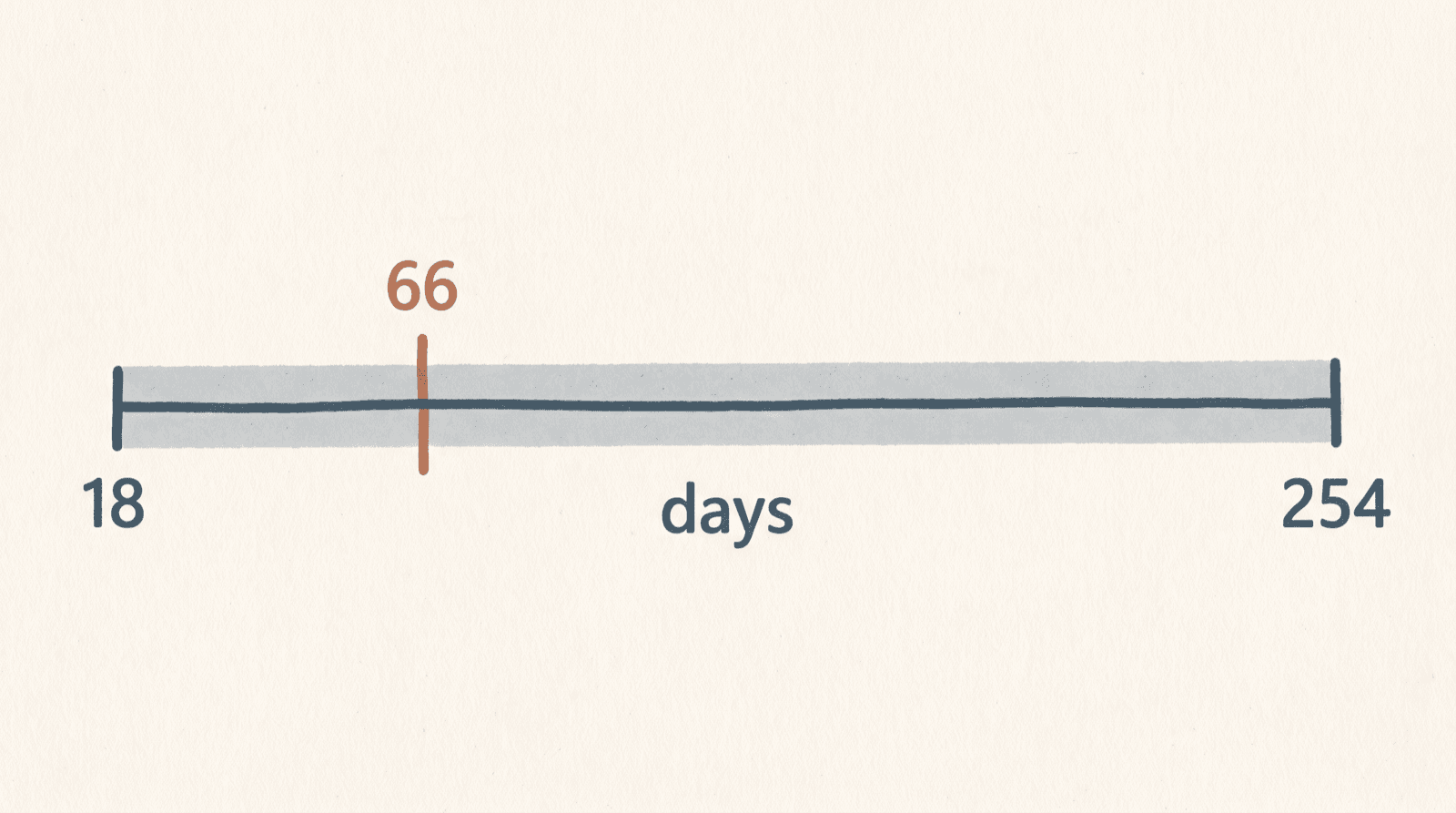
Lally and colleagues (2010, European Journal of Social Psychology) found a median of 66 days to automaticity, ranging from 18 to 254 depending on the person and the behaviour. The finding that matters most for you sits inside that study: a missed day cost 0.29 points on a 42-point automaticity scale, and the next day's entry put it back.
The third time you do this and the thirtieth are genuinely different experiences. Most people stop in between, because of a missed Thursday rather than because the practice failed.
What if you pray and nothing happens
This will sometimes look like it's doing nothing at all. You'll pray for the same 3 people for months and see no visible movement in any of them.
Philip Yancey has written about this more honestly than most. His conclusion in Prayer: Does It Make Any Difference? is that the most important purpose of prayer may be to let ourselves be loved by God.
That's worth sitting with, because everything above could be read as a technique for self-improvement. The honest description is smaller: you're talking to God about people he's been thinking about far longer than you have, and the attention that grows in you is a by-product of that conversation rather than its purpose.
Which also means a silent stretch is the ordinary texture of a relationship with someone you can't see, rather than a verdict on your method.
How to tell whether it's working

Do this before you start. It only works if you capture the "before".
Write the 3 names, and under each one what you know about their life right now. The last thing they told you that mattered. What's happening for them this week.
If you can't write anything under a name, leave it blank and don't go and find out. Blank is the honest answer, and blank is the measurement.
If you'd rather not rule up the pages yourself, the prayer journal template lays out all 4 of them: the baseline, the daily line, the weekly questions and the monthly review.
Come back in 2 weeks and answer the same question on a fresh page. Then read the two pages next to each other.
In what I've seen, attention is the first thing that moves, and roughly 2 weeks is where it starts to show. That's my own observation from doing this and watching others do it, not a research finding, and you should hold it loosely.
If nothing changed, that's information rather than a verdict. Faithfulness and effectiveness are different things, and this practice is designed to keep going when the second one is invisible.
The practice
The action. Write 3 names, people outside your faith community. Pray for each by name before the day ends.
The cost. About 40 seconds a day.
The cue. Somewhere your eyes already go without deciding to look. Lock screen, kettle, the back of your hand.
The measure. Whether you think about these 3 more than you did before, checked against what you wrote on day one. The measure is never whether anyone responded or changed, because that hands you a scoreboard you can't control, and an uncontrollable scoreboard is the fastest way to quit.
What the 40 seconds is actually for
The point of all of this is God himself. John Piper's argument, put simply, is that nearness to God matters because God is worth knowing, and every improvement in you runs downstream of that. What the 40 seconds does to your attention is a side effect.
If you're reading this without being sure you belong to him at all, start with Jesus rather than with the practice. The invitation in the gospels is to come, and it's open to you today, before any of the rest of this applies.
And the people whose names you write are headed somewhere. Revelation 7 describes a crowd nobody can count, from every nation and tribe and people and language, standing in front of the throne.
Your 3 names belong in that crowd, and 40 seconds a day is a small thing to spend on people with that ahead of them.
Common questions
How do I know I'm getting closer to God? Check attention rather than warmth. Write down what you know about your 3 people today, then answer the same question 2 weeks later on a fresh page. If you're noticing more about their lives without trying to, something has moved. Feeling is a poor instrument here because it tracks your sleep and your circumstances more than it tracks God.
What are the 7 keys to intimacy with God? There isn't a fixed list of 7, and any article offering one has chosen its own. Scripture points at a smaller set: God's word, prayer, gathered worship, confession, generosity, and attention to the people near you. The number matters far less than whether one of them has a time cost and a cue attached.
How do I fast to get closer to God? Start smaller than you think. One meal, one day, with the time you'd have spent eating given to prayer instead. Fasting doesn't make God more willing. It clears space, and it exposes what you reach for when you're uncomfortable, which is usually the more useful of the two.
What if I miss a day, or a week? Start again on the next day, with no compensating and no catching up. Lally's 2010 research put the cost of a missed day at 0.29 points on a 42-point automaticity scale. A week off costs you a week. It doesn't cost you the practice, and treating it as a failure is what actually ends these things.
Can I be close to God and still be struggling? Yes, and the assumption that you can't is doing real damage to people. Scripture is full of people close to God and in visible trouble. Closeness is a relationship you keep showing up to, and showing up while it's hard is the part that counts most.