How to Not Be a Lukewarm Christian
To stop being a lukewarm Christian, start with 3 names and about 40 seconds, then check in 2 weeks whether those 3 people are on your mind more than they are today. That's the whole action. The reason it works when reading more and praying harder didn't is that it has a size, a place in your day, and something you can actually check.
How do I stop being a lukewarm Christian?
Pick 3 people. Write their names and one line each on what you're asking God for them, every day, in the same place. It takes about 40 seconds. The measure isn't how you feel about God or what happens to those 3 people, it's whether they're on your mind more than they were 2 weeks earlier.
Before anything else: you are not being spat out
Almost everyone searching this phrase is frightened, and the fear has one source. Revelation 3:16, where Jesus tells the church at Laodicea that because they are lukewarm he will spit them out of his mouth.
Here's what gets left out. The letter doesn't stop at verse 16. Three verses later Jesus says, "Those whom I love I rebuke and discipline. So be earnest and repent." Then: "Here I am! I stand at the door and knock" (NIV).
That's an invitation, and it's addressed to the same people who just got the hardest sentence in the letter. Somebody who has been spat out doesn't get knocked on.
So the honest answer to the question underneath your search is that the anxiety you're carrying is not what the passage hands you. And the popular explanation of what "lukewarm" meant, the one you've probably seen in the last month, turns out not to hold up.
What Revelation 3:16 actually says about being lukewarm
You've likely met this reading: Laodicea's water arrived through pipes, it turned up tepid and unpleasant, and the nearby hot springs healed while cold water refreshed, so lukewarm meant useless. It's on Ligonier, it's in a hundred sermons, and it's circulating on Instagram right now as the detail that flips the verse.
It doesn't survive the archaeology. Mark Wilson traced the aqueduct and found it runs from springs to the south, and he concludes that Laodicea's water "was not inferior, its water not undrinkable, and its temperature not lukewarm" (Tyndale Bulletin 76, 2025, open access).
Wilson's own suggestion about what the metaphor did mean is 1 year old with no scholarly response yet, so treat it as one researcher's fresh proposal rather than the new answer.
What he establishes is enough on its own, and it's the part that matters to you. For Jesus and John, hot and cold are both positive words. Mediocrity is not the emphasis.
Read that way, the charge in the letter isn't that your feelings have cooled to room temperature. It's the thing Jesus says outright 1 verse later, that they believe they're rich and need nothing. The problem named in the text is self-sufficiency, and self-sufficiency is a habit rather than a temperature.
That's better news than it sounds, because you can change what you do about a habit. You cannot manufacture a feeling on demand, which is what most of the advice on this topic quietly asks you to do.
What are the signs of a lukewarm Christian?
You've already decided this applies to you or you wouldn't be reading. So here's the list without the scolding, because you're not looking for a verdict.
Prayer has become a thing you mean to do rather than something you did today. Your Bible gets opened in a service and rarely otherwise. You can't name a person whose life is different because you're in it. Church attendance runs on habit and you'd struggle to say what any of the last 4 talks were about. And the biggest one: you'd describe your faith as fine, and "fine" is the word you'd use to describe a meal you can't remember.
If you're not sure the word fits you at all, what is a lukewarm Christian reads it from the whole letter, and every other page ranking here gives you a list like that. JD Greear gives 8 signs, Crosswalk gives 25 ways out, and wikiHow has a steps guide.
Not one of them tells you what to do tomorrow morning at a size you could actually do it. A sign is only worth reading if it points at something specific, and the diagnosis is the part you already had.
Why what you've already tried hasn't worked
Read the 9 pages that rank for this search, as I did, and they say the same 5 things: read your Bible, pray more, serve people, deal with your sin and control your thoughts.
All 5 are right. That's exactly the problem, because you've already been trying them, which is why you're searching at 11pm for a way to stop being lukewarm.
Not one of those 9 pages gives you a number of minutes, a moment in your day to attach it to, or any way to tell whether it's working. What you get instead is a category of activity and an implied instruction to want it more.
Wanting it more is not available to you. If it were, you'd have used it already.
So the loop runs like this. You read the advice, you resolve to do better, you do better for 4 days, you miss a Tuesday, and the missed Tuesday becomes evidence for the thing you were already afraid of. Then you go looking for another article.
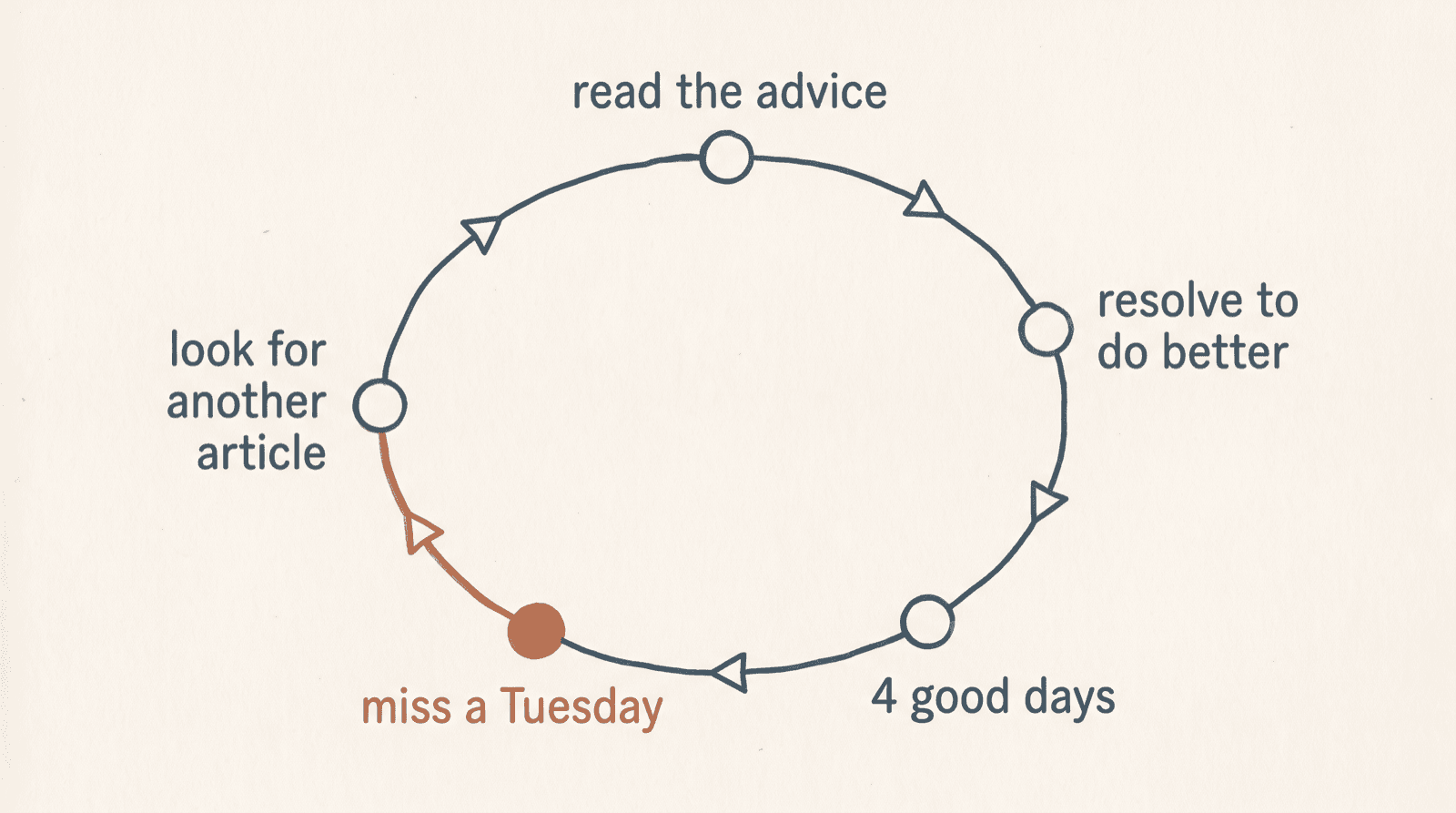
Nothing in that loop is broken except its size. An instruction with no boundary can't be completed, and something you can't complete can't tell you it's working.
Isn't a practice with a measure just works?
Two of the best pages on this SERP say so, and they're worth taking seriously rather than arguing with.
Desiring God calls lukewarmness a symptom of spiritual self-reliance. 1517 puts it harder: to be lukewarm is to take refuge in your own works apart from the works of God. Both are describing a real danger, and giving an anxious person a scoreboard is one good way to walk straight into it.
Dallas Willard drew the line that answers this, and it's the reason there's a practice on this page at all. Grace is not opposed to effort, it's opposed to earning. Effort is an action, earning is an attitude ("Live Life to the Full", Renovaré).
Your standing with God was settled somewhere other than your notebook. Hebrews 10:19 grounds your confidence to walk in on what Jesus did at the cross, and that grounding holds on the weeks you manage nothing at all.
What the practice does is put you in the way of being grown, in the same sense that showing up to a conversation isn't closeness and you can't get close without it.
The measure keeps the line visible, if you pick the right thing to measure. Count answered prayers and you're grading God's responsiveness, which is the trap the pages that do offer a measure fall into. Watch your own attention instead and you're checking whether you showed up, which is the only part that was ever yours.
What happens the day you miss
You'll miss a day, probably sooner than you'd like, and what happens next decides everything.
The spiral says a missed day proves you were never serious. It's worth knowing that this has been measured, and the measurement disagrees.
Lally and colleagues tracked people forming a daily behaviour over 12 weeks (European Journal of Social Psychology 40, 2010). Miss a single day and automaticity drops 0.29 points on a 42-point scale, then recovers 0.55 points the following day against 0.79 for an unbroken run. The gap is real, and it's tiny, and it closes.
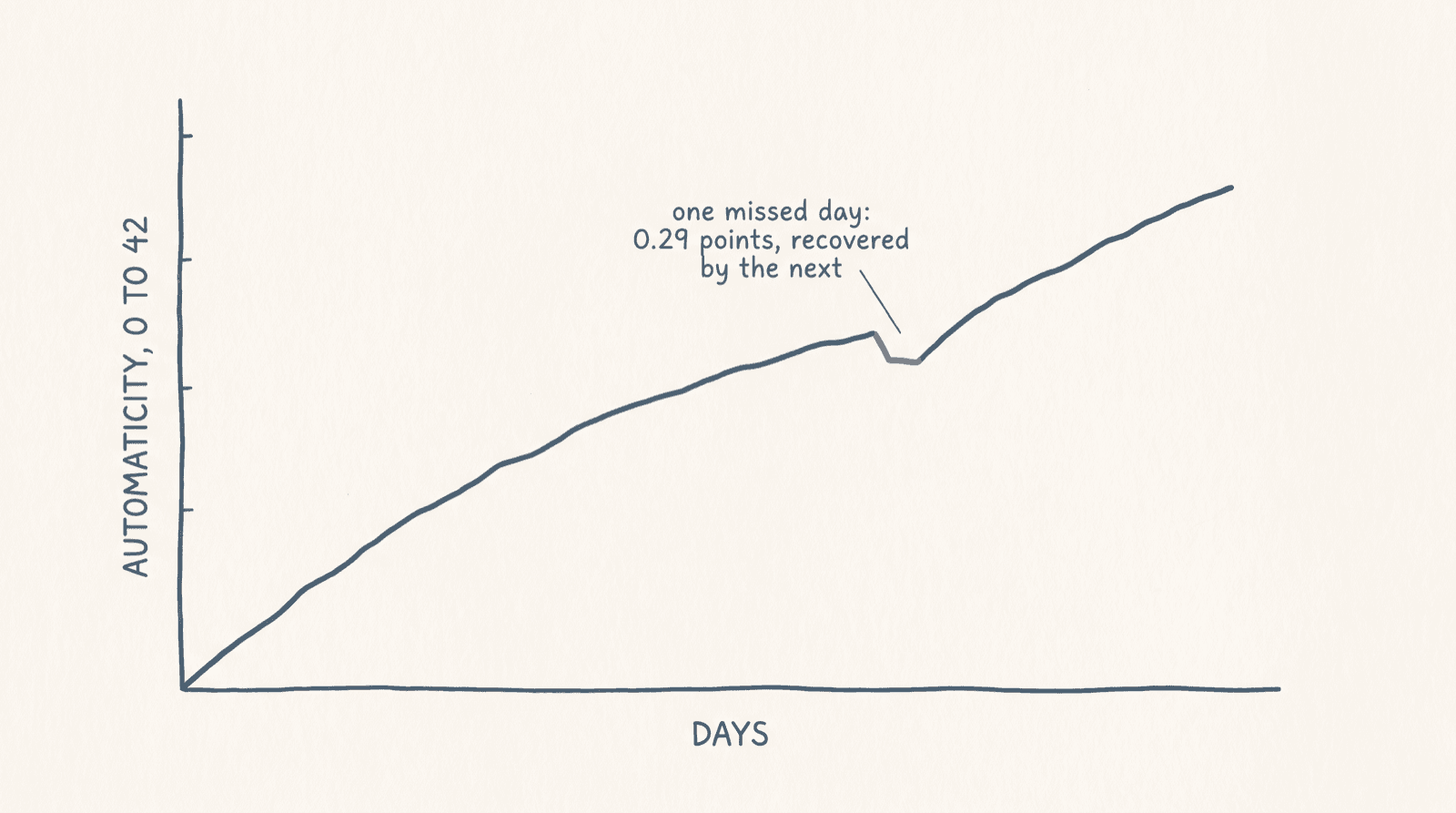
Note that the study measured automaticity rather than whether a habit formed, and its own authors are careful about the difference.
This is why the practice below has no streak counter, no tick boxes and no printed dates. The record is made of names rather than marks, so there's nothing to break and nothing to restart.
The practice: 3 names, about 40 seconds
Tomorrow morning, wherever your phone charges overnight, keep a notebook. Before you pick up the phone, write today's date and the names of 3 people, with 1 line each on what you're asking God for them.
That's it, and it takes about 40 seconds.

Who to pick. 3 people you actually see. A neighbour, someone at work, a family member you're not close to. Not a country and not a category.
The cue. Attach it to the phone, because your eyes already go there without you deciding to look. A practice with no fixed place gets moved until it's gone.
The measure. In 2 weeks, ask 1 question: are those 3 people on your mind more than they were when you started? What you're checking is your own attention, rather than anything that happened to them or how you felt while writing.
In what I've seen, attention is the first thing to move, and roughly 2 weeks is where it starts to show. That's my own observation from doing this and watching others do it, not a research finding, so hold it loosely.
Attention is the thing that went missing while your faith was going flat, and it's the thing you can check without asking God for a receipt.
If you miss tomorrow, write 3 names on Thursday. There's no tally to fall behind on.
One more thing, and it matters more than any of the above. If you're reading this unsure whether you belong to him at all, start with Jesus rather than with the notebook. The invitation in the gospels is to come, and it's open to you today, before any of the rest of this applies.
Common questions
Can a lukewarm Christian be saved?
The letter to Laodicea doesn't end at the spitting-out verse. Three verses later Jesus says he rebukes and disciplines those he loves, and then that he's standing at the door knocking (Revelation 3:19-20, NIV). Rebuke inside a letter that ends with a knock is addressed to someone still being invited in. Christians disagree about whether the people in that letter were believers at all, and the invitation in verse 20 is open to anyone either way.
What are the signs that God is pulling me out of being lukewarm?
Usually it's the discomfort itself. People who are genuinely indifferent to their faith don't search for how to fix it at midnight, and they don't find the word "lukewarm" painful. The unease that brought you to this page is not a sign of the condition getting worse.
How long does it take to stop feeling lukewarm?
Nobody can tell you honestly, and anyone offering 21 days is quoting a number that research has repeatedly failed to reproduce. For daily behaviours the measured median sits around 59 to 66 days, with individuals ranging from 4 days to 335 (Healthcare 12, 2024). In what I've seen, attention moves before the feelings do.
Is being lukewarm the same as backsliding?
They point at different things. Backsliding describes going backwards from somewhere you'd got to. Lukewarm, as the letter uses it, describes believing you're fine and need nothing, which can happen without any visible decline at all. That's why it's harder to notice from the inside.
If the bigger question underneath this one is the one you actually came with, start there instead: how to get closer to God is the same practice without the fear attached.
And if you'd rather write on a page than in a notebook, the prayer journal template rules up all 4 sheets and prints straight from your browser.