Prayer Journal Examples
A prayer journal example needs only 3 things: a date, the names of the people you're praying for, and one line under each about what's happening for them or what you noticed. Below are 6 complete sample entries, following the same 3 people through a first page, an ordinary day, a hard day and a weekly look back, with a short note on why each one is written the way it is.
What does a prayer journal entry look like?
A prayer journal entry is a date, 3 names, and one line under each. On fuller days you can add a verse or a line of thanks. Once a week, write who was on your mind and where you were when they were.
If your entries look thin next to the ones online
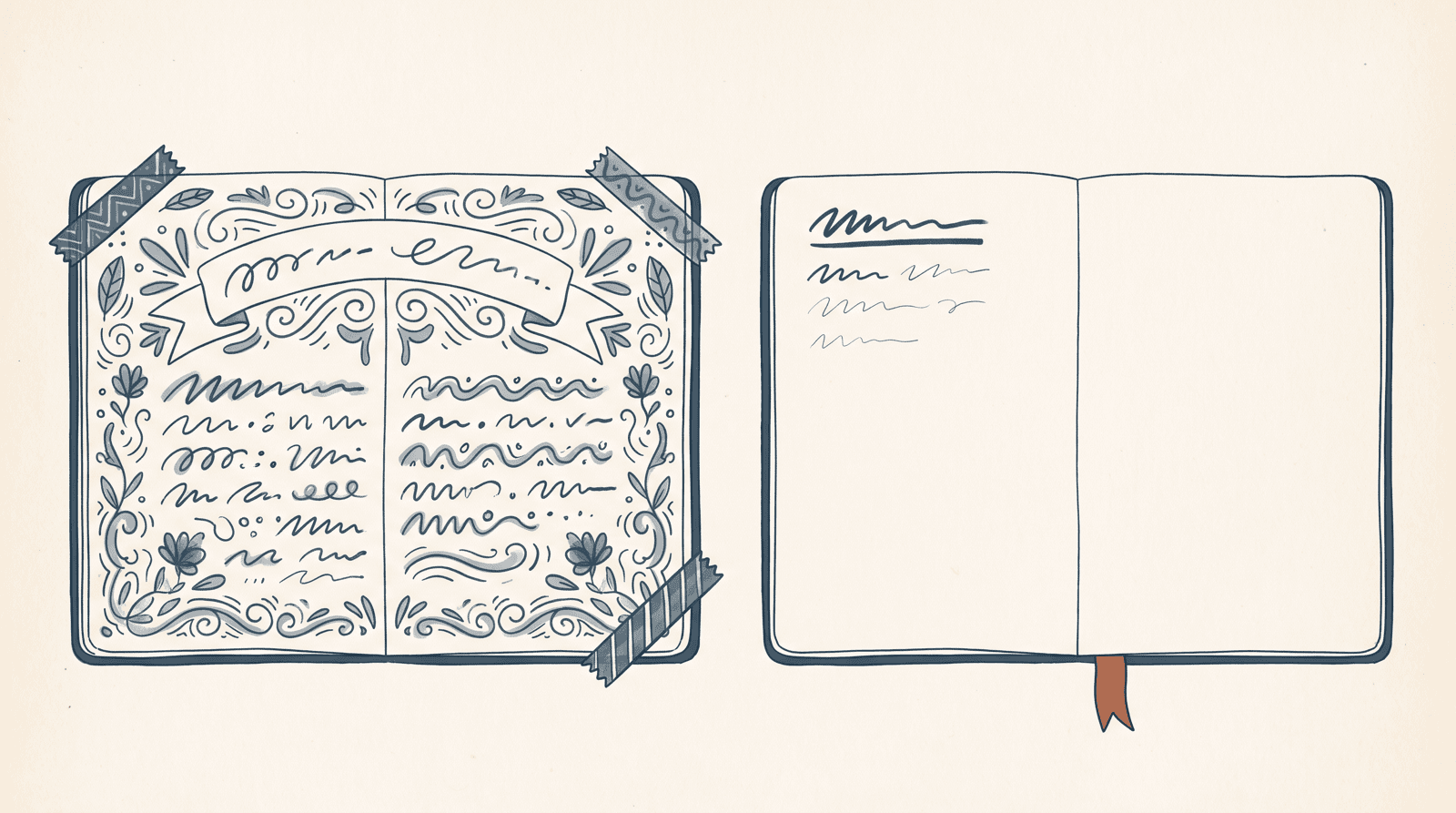
Search for prayer journal examples and you'll find pages of hand-lettered headings, washi tape and half-page prayers. Next to those, 3 names and 3 lines can look like you're doing it wrong.
Jesus told his disciples that God doesn't measure prayer by its length: "do not keep on babbling like pagans, for they think they will be heard because of their many words" (Matthew 6:7, NIV). The next verse gives the reason: "your Father knows what you need before you ask him" (Matthew 6:8, NIV).
A short entry is a complete entry. The samples below are short on purpose.
What do you write in a prayer journal entry?
A prayer journal is a notebook where you write your prayers down, by date. Every sample on this page has the same 4 parts: the day, the names, one line for each, and once a week, a look back.
You'll often see a longer shape suggested, usually ACTS: adoration, confession, thanksgiving and supplication, each with its own section. That's a good frame for a day when you have time, and sample 5 shows how the names fit inside it.
The daily entry here is deliberately smaller than ACTS, because a small entry still gets written on a bad day.
If you want prompts for what to put in the line, the prayer journal prompts page sorts them by the day you're having.
6 sample prayer journal entries
These are samples, written for this page. Dan, Priya and Ruth are made-up names, so put your own 3 people in their place.
Sample 1: the first page
Monday
Dan: new job starts next week, nervous about it.
Priya: her mom's back in the hospital.
Ruth: (don't actually know what's going on with her)
The blank under Ruth is the most useful line on the page. You'll come back to this page in a week and see whether you know more than you did.
Sample 2: an ordinary day
Tuesday
Dan: nothing new.
Priya: nothing new.
Ruth: saw her car outside the store, didn't stop.
Most of your days will look like this. "Nothing new" still records that you brought the name to God today, and that's the whole job of the line.
Sample 3: the day a name came to mind away from the page
Thursday
Dan: (no entry)
Priya: thought of her in the parking lot at work, prayed for her mom there.
Ruth: nothing new.
Wednesday is missing, and nothing in the journal breaks because of it. Writing down where you were when Priya came to mind is what makes this entry more than a list.
Sample 4: a hard day
Friday
Priya: her mom died this morning. I don't know what to ask.
One name, one line. When you can't find words, the psalm invites you to bring God what you have, unfinished: "pour out your hearts to him, for God is our refuge" (Psalm 62:8, NIV).
Sample 5: a fuller day
Saturday
You've been patient with me this week.
I've been short with people at home, sorry.
Thank you for Dan's first day going fine.
Dan, Priya, Ruth: Priya above all today, and the funeral on Wednesday.
This is ACTS in 4 lines: praise, confession, thanks, then the asking. The 3 names stay in the asking, which keeps a fuller day connected to the same people.
Sample 6: the weekly look back
Sunday, the week
Who was on my mind, and where was I?
Priya, most of all: the parking lot Thursday, and twice in the kitchen.
Dan, once, when his text came in.
Ruth, barely. I still don't know how she is.
This is the entry that tells you whether the practice is working. Compare it with sample 1 and you can see the week: Priya filled it, Dan came up once, and Ruth is still a blank worth doing something about.
Are there prayer journal examples in the Bible?
The closest thing scripture has to a prayer journal is a letter that records prayers for named people and churches.
Paul opens his letter to the church at Philippi with one: "I thank my God every time I remember you. In all my prayers for all of you, I always pray with joy" (Philippians 1:3-4, NIV). To one man, Philemon, he writes, "I always thank my God as I remember you in my prayers" (Philemon 1:4, NIV).
Long before Paul, Samuel told Israel that he would keep praying for them, whatever they had done: "far be it from me that I should sin against the LORD by failing to pray for you" (1 Samuel 12:23, NIV).
The habit carried on through church history. Richard Foster, in an excerpt from his 1994 book Coming Home published by Renovaré, traces kept prayer journals from Augustine's Confessions to Pascal's Pensées and John Woolman's Journal.
What Paul's letters share with the samples on this page is the names. Paul prays for people he could picture.
What makes a good prayer journal entry?
A good prayer journal entry is short, uses names, records where your attention went, and is honest when there's nothing to say. All 6 samples above follow those 4 rules.
It's short enough to write on Friday, the day Priya's mom died. It uses a name like "Ruth", because you can't notice a category like "my friends" in a parking lot.
It keeps the blanks, too. "Don't actually know what's going on with her" under Ruth is the most honest line of the week.
Writing it down matters. Harkin and colleagues, in a 2016 review in Psychological Bulletin covering 138 studies and 19,951 people, found that monitoring progress toward a goal helps you reach it (d+ = 0.40), with larger effects when the information is physically recorded.
Harkin's review covers goals in general, and none of its studies tested prayer. Applying it here is a reasonable inference from a moderate effect, so read it as a reason to write things down. It makes no promise about what happens when you do.
Why do these samples leave out an answered-prayer log?
These samples keep the answered-prayer log out of the daily entry because a log of answers can quietly become a scoreboard, and a scoreboard reads badly in a week like the one Priya just had. The prayer journal template sets out the longer reasoning.
When we checked in October 2026, 3 of the 7 example pages we read for this search, and both of Google's AI Overviews, tracked answered prayers. Remembering what God has done is good. In Psalm 77 it's how a sleepless, troubled writer finds his footing again: "I will remember the deeds of the LORD" (Psalm 77:11, NIV).
So write down what God has done whenever you see it, and keep your measure on the names. Some of these prayers won't get an answer you can see in this life. Revelation pictures them kept before Jesus, the Lamb, in "golden bowls full of incense, which are the prayers of God's people" (Revelation 5:8, NIV).
How do you turn these examples into your own entry?
Start with sample 1, with your own 3 names, today. Samples 2 to 6 come later, on the days that call for them.
If you'd like a walk through the first week before you begin, how to start a prayer journal takes it one day at a time. Printable pages are below.
If you miss a day, start again on the next date. Lally and colleagues found that missing a single day "did not materially affect the habit formation process" (European Journal of Social Psychology, 2010).
The practice
The action. Copy sample 1 into any notebook today: the date, your own 3 names, and one line under each.
What it costs. About 2 minutes today, then about 40 seconds a day. That's my own count, so treat it as an estimate.
Where to put it. Put the 3 names on your phone's lock screen and the notebook beside the kettle, so your eyes land on them without you deciding to look.
How you'll know it's working. In a week, write your own sample 6: who was on your mind, and where were you when they were? Then compare it with your first page. The measure is how much more you noticed about those 3 people.
You can bring God a page this small with confidence, because the welcome was never earned by the length of your prayers. Jesus went to the cross so that you could come near. If you've never come to God through him, you can start there, in your own words, on the first page.
Common questions
Can you give me a simple prayer journal example?
The simplest working entry is a date and 3 names, each with one line: "Dan: new job next week, nervous. Priya: mom back in the hospital. Ruth: don't know." That's a complete prayer journal entry. Everything else, such as verses, thanks or longer prayers, can be added on days when you have the time.
What is a good journal for prayer?
Whatever notebook you'll actually see every day. A cheap notebook beside the kettle beats a beautiful guided journal in a drawer. A notes app works too. Choose by where it will live, then buy a nicer one later if you still want to.
What are the 7 P's of prayer?
There's no single agreed list, and the phrase doesn't come from the Bible. Bishop Anthony Taylor of Little Rock, in a 2016 homily, drew 7 from the Lord's Prayer: presence, praise, purpose, petition, pardon, protection and persistence. A ChurchLeaders article builds a different 7 from Elijah's prayer. They're memory aids, so use one if it helps. The prayer journal template covers how they relate to ACTS.
Do I need a Bible verse in every entry?
No. A verse is a good addition on a fuller day, like sample 5, and some people anchor every entry in one. But a verse requirement can turn a 40-second entry (my own estimate) into a much longer one, and a longer entry is harder to keep on a bad day. The names come first.
Should I write my prayers as a letter to God?
You can, and some people do. Letters suit long, reflective days. The samples here use one line per person because a line survives a bad day and a letter often doesn't. If you write letters on good days, keep the names-and-lines entry for the others.
Get the printable pages
The free printable pages give you the first page, the daily lines and the weekly look back, ready to fill in from today.