How to Start a Prayer Journal
To start a prayer journal, take any notebook and write 3 names on the first page: people you know, each with one line about what's happening in their life. Each day after, write the same 3 names and one line on what you noticed. By my own count that takes about 40 seconds. The first 7 days are when a new habit is at its weakest, so here's what each one asks of you.
How do you start a prayer journal?
Use any notebook you already own. On page 1, write 3 names and one line each about what's happening in their lives, then write the same names daily in under a minute. Your measure is who was on your mind this week.
If there's already a prayer journal in your drawer
If you're searching this, you may have started one before. It had a nice cover, the first entry ran a full page, and somewhere around day 5 it stopped.
That abandoned journal tells you the format was too big to carry on an ordinary Tuesday.
The research on habits is kinder than you might expect. In Lally and colleagues' 2010 study of how habits form, published in the European Journal of Social Psychology, missing a single day "did not materially affect the habit formation process". So a gap in the old journal doesn't count against the new one.
What is a prayer journal, and how is it different from a diary?
A prayer journal is a written record of who you've brought to God and what you've noticed since. A diary records your day and how you felt about it.
Richard Foster, in an excerpt from his book Coming Home published by Renovaré, puts it this way: if prayer is "the ongoing interaction we have with God", a prayer journal "preserves those interactions, events, and reflections". He calls it "an Ebenezer of sorts", after the stone Samuel set up to mark that God had helped Israel.
The version on this site narrows that to something you can keep on a bad week. It's a record of attention to 3 named people, kept in the presence of God.

The key elements are small: a date, the names, one line, and a short look back at the end of each week. How those fit on the page is laid out in the prayer journal template, so this article won't repeat it.
What do you need to start one?
Whatever notebook is closest to you right now. A guided journal can be lovely, but buying one first turns the start into a shopping trip, and shopping feels like progress without any prayer in it.
Paper or a phone note both work. What matters is that the names end up written down.
There's evidence that writing it down helps. Harkin and colleagues (2016, Psychological Bulletin) reviewed 138 studies covering 19,951 people and found that monitoring progress toward a goal helps you reach it (d+ = 0.40), with a larger effect when the information is physically recorded.
Harkin's review covers goals in general, though. No study I've found tests this on prayer or spiritual formation, so treat it as a reasonable inference with a moderate effect.
Where the notebook lives matters more than which notebook it is. A journal on a shelf waits for you to remember it, which is why the prayer journal template puts the names somewhere your eyes already land.
Your first 7 days, day by day
Day 1. Write 3 names. Under each, write one line about what's going on in their life this week. If you can't write anything under a name, leave it blank. That's honest, and it gives you something to compare against on day 7. This takes about 2 minutes, by my own count.
Day 2. Write the same 3 names, then one line about anything you noticed. "Nothing" is a valid entry, and on day 2 it's the usual one.
Day 3. This is often the blank-page day, when the novelty has worn off and you sit there unsure what to say. The section below deals with it.
Day 4. Around here, writing prayers can start to feel like going through the motions. That has its own section too, because it happened to me.
Day 5. If you're going to miss a day this week, it may well be this one. If you miss it, write the next date on the next line and carry on. There's no grid to fail.
Day 6. At some point this week, one of the names will probably come to mind away from the page, in the car or at the shops. When it does, pray for them right there, then jot down where you were.
Day 7. Ask yourself one question: who was on your mind this week, and where were you when they were? Write the answer under the week's entries. The prayer journal template has the full weekly page if you want more than 1 question.
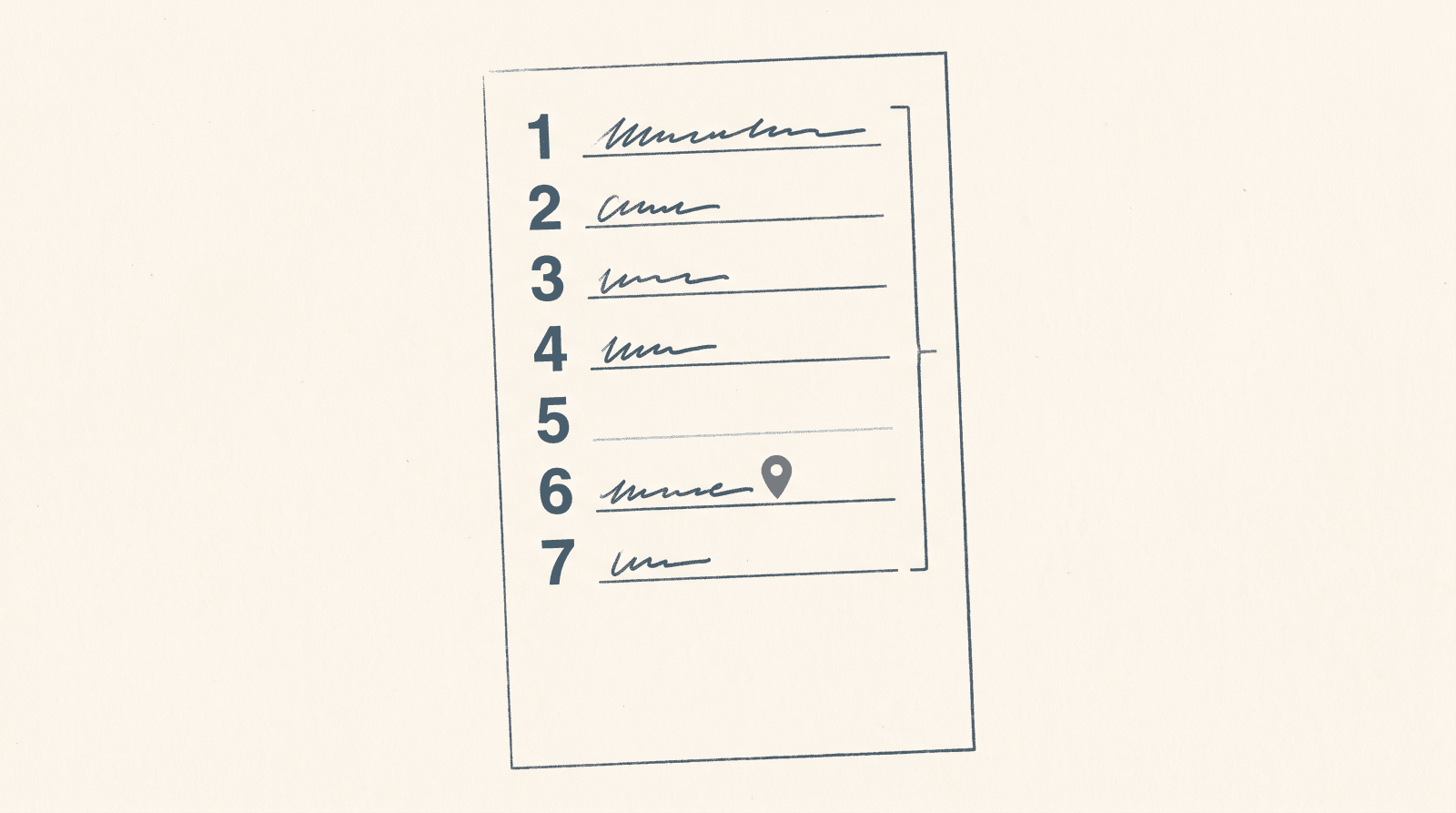
That's a whole week of prayer journaling, and by the same count it fits in about 6 minutes in total. If you'd like to see what those entries look like written out, there are 6 prayer journal examples here.
What if you don't know what to write?
Write the name. Bringing a person's name to God is a real prayer even with nothing added, and writing it down records that you brought it.
Paul says the not-knowing is expected: "the Spirit helps us in our weakness. We do not know what we ought to pray for, but the Spirit himself intercedes for us through wordless groans" (Romans 8:26, NIV).
So one line is the ceiling for a beginner, and an empty line under a name is still a day you prayed for them.
On fuller days, when you want more than a name, the prayer journal prompts page has a short list sorted by the day you're having.
What if it feels fake?
If the page feels like a performance, shrink it to the names alone. The journal records who you talked to God about, and the talking happens wherever you are.
At one point, writing my prayers down felt like going through the motions, so I stopped for a while to remind myself what I actually wanted, which was to be closer to God. The most natural way to do that turned out to be talking to him and listening, and I found prayer came far more easily when I prayed as thoughts occurred to me.
That's the useful thing about the fake feeling. It sends you back to why you started, and the why was nearness to God all along.
Jesus pointed the same way: "when you pray, go into your room, close the door and pray to your Father, who is unseen" (Matthew 6:6, NIV). Two verses later he adds that "your Father knows what you need before you ask him" (Matthew 6:8, NIV), which means your entry doesn't need to be long or well phrased.
How do you keep a prayer journal going after the first week?
Expect it to take longer than a week to feel automatic. Lally and colleagues (2010) found a median of 66 days for a new daily behavior to become automatic, with individuals ranging from 18 to 254 days.
A 2024 meta-analysis in Healthcare put the medians at 59 to 66 days and explicitly rejected the popular 21-day figure. So if day 12 still takes effort, you're right on schedule.
After week 1, the daily line stays exactly the same size. Growing it is the fastest way back to the drawer.
What grows is the look back: the weekly question and, once a month, a comparison with what you wrote on day 1. The template's monthly page is built for that.
Dallas Willard defined a discipline as "something in my power that I do to enable me to do what I cannot do by direct effort" ("Live Life to the Full", Renovaré). Writing a line is in your power, and the look back is where you notice what God has been doing.
Some weeks you'll notice nothing, and the line still isn't wasted. Paul ends his chapter on the resurrection by telling the Corinthians that their "labor in the Lord is not in vain" (1 Corinthians 15:58, NIV).
And a missed day is a blank line, nothing more. Start again on the next one.
The practice
The action. Today, in whatever notebook is nearest, write 3 names on page 1 and one line under each about what's happening in their life right now.
What it costs. About 2 minutes on day 1 and about 40 seconds a day after that. Both are my own count, so treat them as estimates.
Where to put it. Put the 3 names on your phone's lock screen and the notebook beside the kettle, so your eyes land on them without you deciding to look.
How you'll know it's working. On day 7, without looking back, write what you know is happening in each person's life this week. Then turn to page 1 and compare. The measure is how much more you now know and have noticed about those 3 people.
You can come to God with this, however small it is, because Hebrews says you can: "Let us then approach God's throne of grace with confidence" (Hebrews 4:16, NIV). That confidence rests on Jesus, who went to the cross so that you could come near.
Common questions
What should the first page of a prayer journal say?
3 names, each with one line about what's happening in that person's life right now. Leave a line blank if you don't know, because the blank is honest and you'll compare against it later. A date at the top is enough of a heading. Verses, gratitude lists and dividers can come later, once the daily entry has stuck.
Should a prayer journal be on paper or in an app?
Either works. What matters is that it's written down and that you'll see it without deciding to look. Paper beside the kettle and a phone note on your lock screen both pass that test. A beautiful journal in a drawer doesn't.
What are the key elements of a prayer journal?
A date, the names of the people you're praying for, one line about what you noticed, and a short look back once a week. Many journals add answered prayers and long reflections. Those are fine as extras, but a beginner only needs the first 4.
How long should a prayer journal entry be?
For the first few weeks, one line. Short entries survive bad days, and bad days are where journals usually stop. If you want to write more on a good day, go ahead, but don't let the long entry become the standard you measure yourself against.
Do I have to be a Christian to keep a prayer journal?
You can keep one however you like, though prayer assumes you're talking to someone, and on this site that someone is Jesus. If you've never spoken to him and you'd like to, you can do it today in your own words. No set formula is needed.
Get the printable pages
If you'd rather not set the pages up yourself, the free printable prayer journal pages give you the baseline, the daily line and the weekly question, ready to use from day 1.